This post contains affiliate links. If you purchase through my links, I may earn a small commission at no extra cost to you. Thank you for supporting Gear For Trail!
Writing this article I wanted to make a confession… My first wild camping trip was a disaster. Not the dramatic kind where someone gets airlifted out, just the quietly miserable kind where you lie awake at 2am, cold and damp, staring at the ceiling of your tent wondering if you zipped it properly, and mentally listing everything you forgot to bring.
I forgot a groundsheet. I brought the wrong sleeping bag. And I packed enough food for three people when I was going alone.
Twelve years and more overnight trips than I can count later, I can tell you that wild camping is one of the best things I’ve ever done with my time. But I could have saved myself a lot of miserable nights if someone had just told me a few basic things upfront. This is that article.
What wild camping actually means
Definitions vary depending on where you are. In the UK and much of Europe, wild camping means pitching your tent away from official campsites, usually on open land, hillsides, or in forests. In some countries it’s perfectly legal. In others it’s a grey area that most people navigate without trouble if you follow the basic rule of leave no trace: arrive late, leave early, leave the spot exactly as you found it.
In the US it’s often called dispersed camping or backcountry camping, and the rules depend on the land you’re on. National forests generally allow it freely. National parks usually require a permit.
Check the rules for wherever you’re going. It takes five minutes and saves a lot of stress.
The gear that actually matters
I’ve bought a lot of camping gear over the years. Some of it was brilliant. A lot of it was expensive mistakes that taught me to read reviews more carefully before reaching for my wallet. Here’s what I’d tell my younger self to prioritize.
Sleeping bag: your most important purchase
Get this wrong and nothing else matters. I spent my first couple of trips in a bag that was rated to temperatures it absolutely couldn’t handle, and I paid for it with several cold, sleepless nights, but I can learn from my suffering.
For three-season wild camping, you want a bag rated to at least 20 degrees Fahrenheit (6°C). Down insulation packs smaller and lasts longer than synthetic. The best budget down bag I’ve come across is the Kelty Cosmic Down 20. It’s been a bestseller for years, has 50,000 plus five-star Amazon reviews from the Kelty brand, and gives you real down insulation without requiring you to remortgage anything. It compresses well, packs small, and handles temperatures from early spring through late autumn without complaint.
One thing nobody tells you: the temperature rating on sleeping bags is a lower limit, not a comfort rating. If the bag says 20 degrees, you’ll survive at 20 degrees, but you probably won’t sleep well. Buy a bag rated 10 degrees colder (5°C) than the lowest temperature you expect to camp in.
Sleeping pad: the thing most beginners skip
Skipping the sleeping pad is the number one beginner mistake. It’s not only about comfort, it’s about insulation. Cold air rises from the ground all night, and your sleeping bag does almost nothing to stop it from below. You can be in a brilliant bag and still freeze because you didn’t insulate yourself from the ground.
The Therm-a-Rest NeoAir XLite NXT is the gold standard, but it’s expensive. For beginners, a basic foam pad or an entry-level inflatable does the job. What matters is that you have one.
Tent: lighter than you think you need
For wild camping where you’re carrying everything on your back, a heavy tent will ruin your day before you even get to the campsite. I learned this the hard way after a twelve-mile day with a tent that weighed nearly four kilograms.
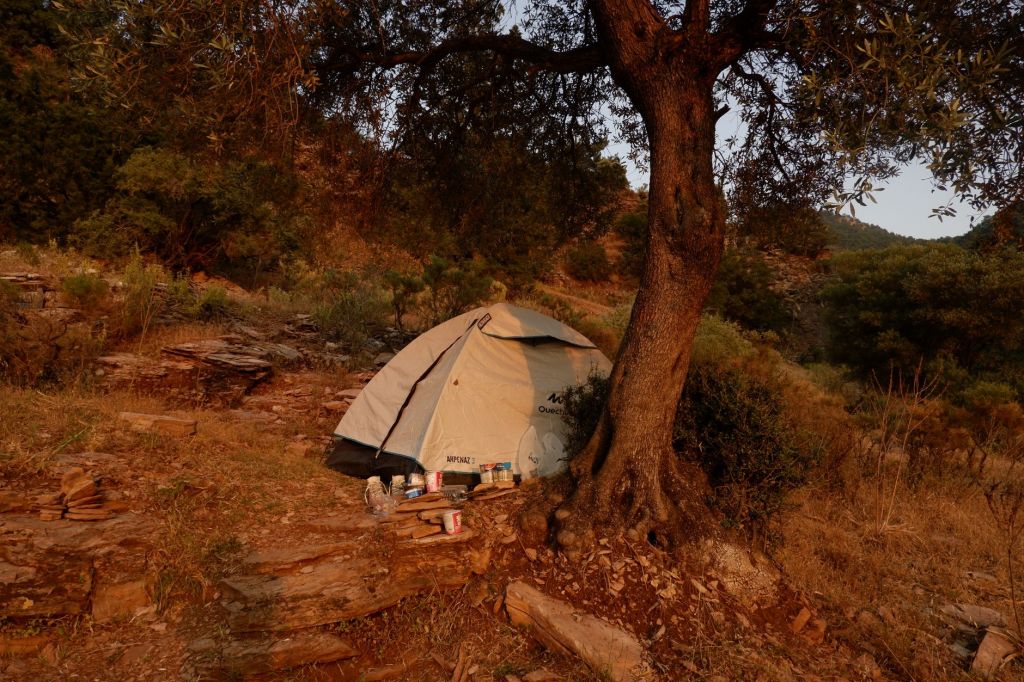
You don’t need anything exotic. A decent two-person, three-season tent in the one-and-a-half to two kilogram range handles almost everything you’ll encounter. Set it up in your garden before the first trip. Not because you’ll forget how, but because discovering a broken pole or a missing peg at dusk on a hillside is a uniquely horrible experience. I really like this tent myself. It’s light, good quality, very useful and the price is very good:
Headlamp: not a torch, a headlamp
You need your hands free at night. Cooking, navigating, rummaging in your bag, going to the bathroom in the dark. A headlamp does all of this. A torch in your hand doesn’t. Bring spare batteries. The number of times I’ve watched the light slowly fade at the exact wrong moment is embarrassing. I can highly recommend PETZL ACTIK Headlamp. It’s a powerful 450 lumen headlight.
Water filter: non-negotiable in the backcountry
If you’re camping near streams or rivers, a water filter means you never have to carry more than about a litre at a time. The Sawyer Squeeze is cheap, light, and filters effectively. I’ve used mine on every wild camping trip for years and it’s never let me down. Fill up, filter, drink, repeat.
The stuff nobody puts on the beginner lists
A lighter. Two lighters, actually. Keep one in your pack and one in your jacket pocket. I forgot this on an early trip and spent a cold, dark evening eating uncooked rice. Not my finest hour. (Okay, I ate the cereal bar I’d packed as an emergency backup. Still not my finest hour.)
Biodegradable soap. Regular soap contaminates water sources. If you’re wild camping near a stream, use biodegradable soap and wash at least fifty metres from the water.
A small trowel. Nature calls at inconvenient times in inconvenient places. The correct method is a cat hole: six to eight inches deep, at least two hundred feet from any water source. Bring the trowel and use it. Everyone else out there will thank you.
A dry bag for your sleeping bag. If it rains and your pack isn’t fully waterproof, a wet sleeping bag at the end of a long day is one of the worst feelings in outdoor recreation. A simple dry bag costs very little and prevents it completely.
The campfire question
I love a campfire. There are few things better than sitting around a fire in the dark in the middle of nowhere, cooking something over the flames, watching the sparks disappear up into the trees. If you know how to do it safely and it’s legal where you are, a campfire adds something to a wild camping trip that a stove simply can’t replicate.
But know the rules. In dry conditions or sensitive ecosystems, open fires can cause serious damage. In some areas they’re prohibited entirely. Check before you go, use an existing fire ring where one exists, and never leave a fire unattended. Leave no trace means the fire too.
What to expect on your first night
You will probably sleep worse than you do at home. Not because wild camping is uncomfortable once you have the right gear, but because your brain will spend the first few trips interpreting every sound as something that might be coming to investigate your tent.
It isn’t. It’s usually a bird, a squirrel, or the wind. After a few trips you’ll sleep better outdoors than you do in your own bed. Until then, accept it, and know it gets better.
What you won’t be prepared for is how quiet it gets in the middle of the night, miles from anywhere. Or how dark it actually is without light pollution. Or how good breakfast tastes when you’ve cooked it on a tiny stove with your hands wrapped around a hot cup of coffee and the mist is still sitting on the hills around you.
That part I can’t teach you. You just have to go.
What’s holding you back from your first wild camping trip? Drop it in the comments and I’ll try to help. 👇
 Gear For Trail
Leave a comment